My roadmap out of chronic symptoms
Gail Hodgson
UNDERSTAND | LIVE | HEAL
This is the short guide I wish someone had handed me when I was searching for answers.
Before I began this approach, I had my symptoms assessed by medical professionals. You must do the same, so that conditions needing medical treatment can be identified or ruled out. New symptoms should always be checked by a medical professional, and prescribed medication should not be stopped without discussing it with your clinician.
This is my story, and I hope it gives you a map to follow with more confidence. If you are anything like I was, you have had the tests and sought medical advice, but you still feel like poop. Here, I share the understanding and changes that helped me get back to living fully.
When I was really unwell, I already had a sense that my mind was playing a part in what I was experiencing, but I didn’t know how to address it. Where do you start? How do you turn that understanding into something that actually helps?
That is why I’ve written this roadmap. It is the starting point I wish I’d had—a way to share what helped me understand my symptoms, let go of fear and begin finding my way back to life.
My story began in my twenties
My back pain began when my first child was about six months old. I blamed lifting a baby. It came and went, moving from my right hip and lower back to the left. Sometimes it was so agonising that I needed help getting out of a chair, or could not get up at all.
That pattern continued until I was 30, when I separated from my husband. I did not connect the two then; looking back, the timing feels significant. After a few pain-free years, the pain returned in my upper spine. Osteopathy brought relief, but the pattern kept returning.
Around 2020, I read Healing Back Pain by Dr John Sarno and began putting his ideas into practice. My back pain gradually went. But I thought TMS only applied to back pain. I did not realise it might help me understand the other symptoms that followed.
The search for answers
In 2020, after a period of prolonged stress, I began experiencing a much wider range of symptoms. Once that stressful period was over, I did not feel stressed anymore. I felt calm. That made it hard to imagine that stress could still be part of what was happening.
I kept seeking answers: GP appointments, tests, private consultations and endless research. I spent thousands of pounds on consultations and supplements, trying to fix myself. I had all nine amalgam fillings removed, and a root canal-treated tooth removed and replaced with a bridge. None of it brought the recovery I was searching for.
What life with symptoms felt like
I share the range of my symptoms because I remember thinking, "But surely this cannot apply to what I have?" These are symptoms I experienced.
The symptoms I have described
Sleep and energy: severe insomnia, sleep deprivation and fatigue that was at times crushing. I did not have a diagnosis of CFS, but the exhaustion could be overwhelming; feeling unwell; heavy or tired eyes; feeling worse after exercise.
Head and balance: vertigo, dizziness and balance problems; ear pressure or fullness; head pressure, headaches and migraines; eye pain and iritis; jaw tension and TMJ symptoms.
Pain and tension: recurring back and hip pain; upper-spine, neck and shoulder pain; joint pain that moved around; ankle tendon pain, knee soreness and finger swelling.
Digestion and food: nausea, bloating, digestive problems, constipation and food intolerances or sensitivities; episodes of sneezing, itching, aches and fatigue that I associated with histamine. A private GP specialising in menopause and histamine suggested that these histamine-type reactions could be MCAS.
Other symptoms: anxiety, palpitations, shallow breathing, hot flushes, urinary frequency, urethral burning, cystitis-type symptoms and pelvic discomfort.
My life became smaller. I feared foods, exercise and anything outside my safe routine, especially if it might stop me sleeping. Insomnia was the worst and scariest symptom for me. I was still teaching yoga, and felt like a fraud: teaching wellbeing while feeling like shit.
When healing became my full-time job
I became obsessive about my healing protocols. I made them my full-time job, and my life began to revolve around trying to get well. Looking back, that pressure was not helping me heal—it was adding more stress to my bucket.
The tools I used were helpful, but making my whole life revolve around them kept me stuck in feeling sick and constantly trying to fix myself. I had to let go of a lot: the strict routines, the checking, and the feeling that I had to do everything perfectly. Learning to use the tools without letting them run my life was a big part of my recovery.
Menopause was happening too
People around me said, "It is menopause - just take HRT." I tried it, but felt worse. That was my experience; it is not a verdict on HRT for anyone else. I now feel that changing hormones exposed how much strain my body had been carrying - as though they had previously been masking it. This is how I make sense of my experience, rather than something I can prove medically. Menopause was part of the picture, but it did not explain everything for me.
A different understanding
Learning more about TMS, neuroplastic symptoms and nervous-system sensitisation changed my direction. My symptoms were real. What changed was how I understood them and responded to them. Today, I’ve recovered.
What is TMS
TMS stands for Tension Myositis Syndrome, a term used by Dr John Sarno to describe real physical pain linked to stress and emotional processes. His approach is now often discussed more broadly using terms such as mind–body symptoms and neuroplastic symptoms.
The brain and nervous system can learn patterns of pain or other symptoms that continue even when there is no ongoing injury driving them. The symptoms are real, not imagined. Learning to recognise these patterns and respond with less fear can help change them.
Understanding the sensitised system
The bucket analogy

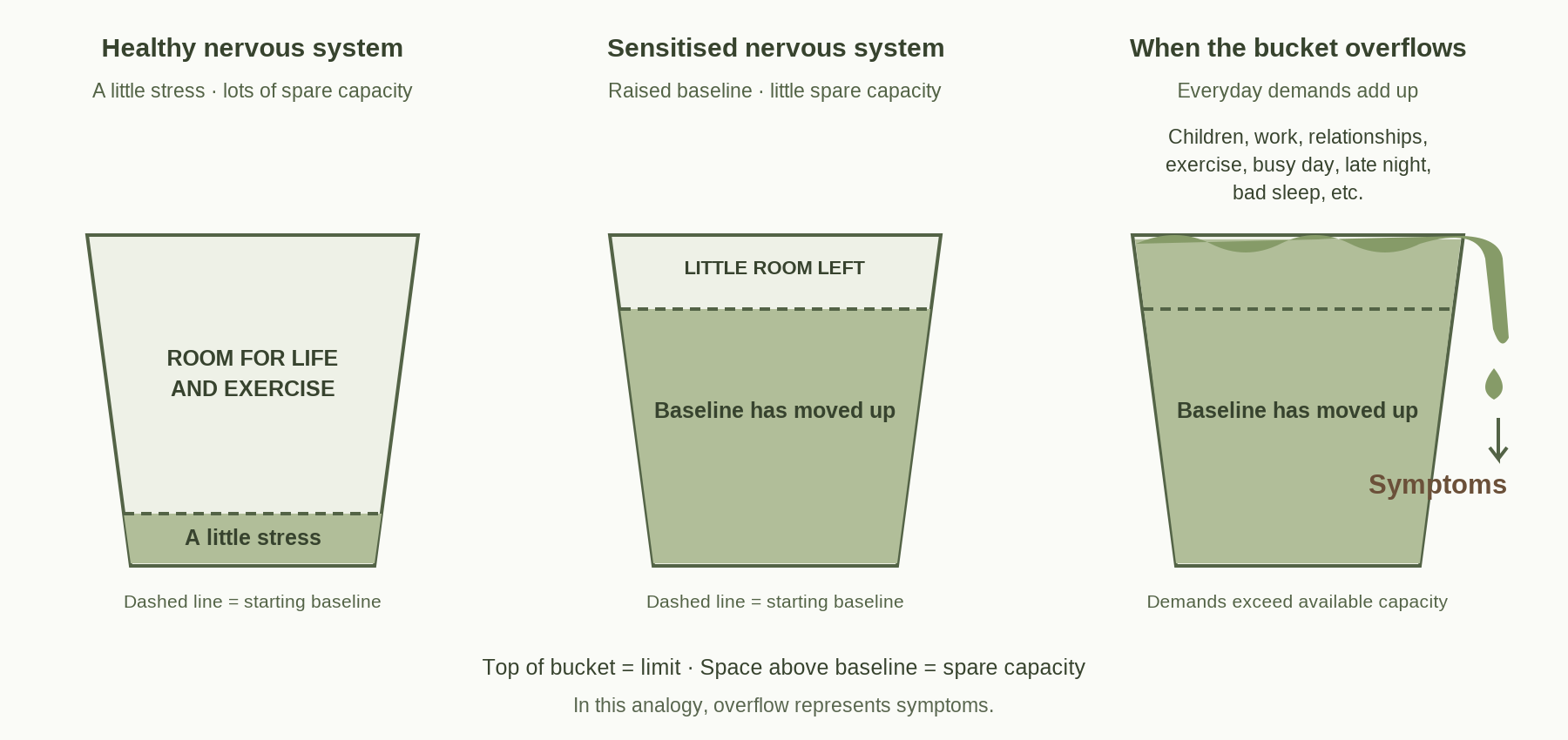
Imagine a bucket holding the demands on your system: prolonged stress, poor sleep, illness, emotional strain and fear of symptoms. When it is nearly full, even an ordinary demand can feel like too much. Overflow represents symptoms in this analogy. It helped me understand why I could feel mentally calm while my body still reacted to everything.
Once the stressors were over, I did not feel stressed. I felt back to normal — my normal. This is where it was so confusing. Whenever anyone suggested stress, I would say, “But I’m not stressed!” And I meant it: I did not feel stressed in that moment.
What I had not realised was that, in the stress-bucket analogy, my baseline had moved up significantly, leaving me with very little capacity for any additional stress. Feeling back to my normal did not mean I had regained the spare capacity I once had. An ordinary demand — exercise, a busy day, excitement or something that would previously have felt manageable — could be enough to tip my bucket into overflow (see illustration below).
Understanding this helped me make sense of the gap between how calm I felt mentally and how reactive my body had become. I did not have to feel consciously stressed for my system to have very little room left for extra demands.
A healthy and a sensitised nervous system
In a healthy nervous system, everyday stress can turn your system up, but there is usually room to meet extra demands and settle again. When you feel dysregulated after stress, practices such as gentle yoga, breathwork and rest can help you return towards your usual baseline.
Sensitisation can develop after a prolonged period, or repeated periods, of stress. In the bucket analogy, your baseline moves upwards, leaving less room before you reach your limit. Where you once had spare capacity, now even ordinary demands can feel like too much. This is one possible route to sensitisation; illness, injury and other factors can also contribute.
Change takes time and consistency. Everyone is different, and there is no fixed timetable for recovery.
In this picture, the baseline is your starting level, and the top of the bucket is your limit. The space between them is your spare capacity: room for demands such as work, relationships, exercise, excitement or a busy day.
With a sensitised system, the baseline is already raised, leaving very little room for additional demands. In the bucket analogy, when those demands exceed the space available, the bucket overflows: symptoms appear or existing symptoms worsen. Something you once managed easily can now feel like too much.
Understanding the learned loop
Your brain is part of your nervous system. Together with your spinal cord and the nerves throughout your body, it sends and receives messages. These messages help you sense what is happening and respond.
A neural pathway is a route along which nerve cells pass messages. Think of it like a path through grass: the more often a response is repeated, the more familiar and automatic it can become. This ability to change through experience is called neuroplasticity.
When the nervous system becomes sensitised, its alarm can become easier to trigger, and sensations can feel stronger. It is like the volume has been turned up. Stress, illness or injury can contribute to this. Fear and constant checking can then help keep that alarm switched on: a symptom feels threatening, fear rises, and the symptom gets more attention. That is the learned loop shown below.
The ability to learn also gives us a way to practise a different response. For familiar neuroplastic symptoms, noticing the sensation without treating it as danger gives your brain a different experience. Returning to manageable activities gives it further opportunities to learn safety. Repeated over time, this can help the fear response become less automatic and the alarm settle.
Think of this as practising a new path rather than repeatedly walking the old fear path. You do not have to do it perfectly or make the symptom disappear in that moment. For me, understanding that my system could learn and change was hugely empowering.
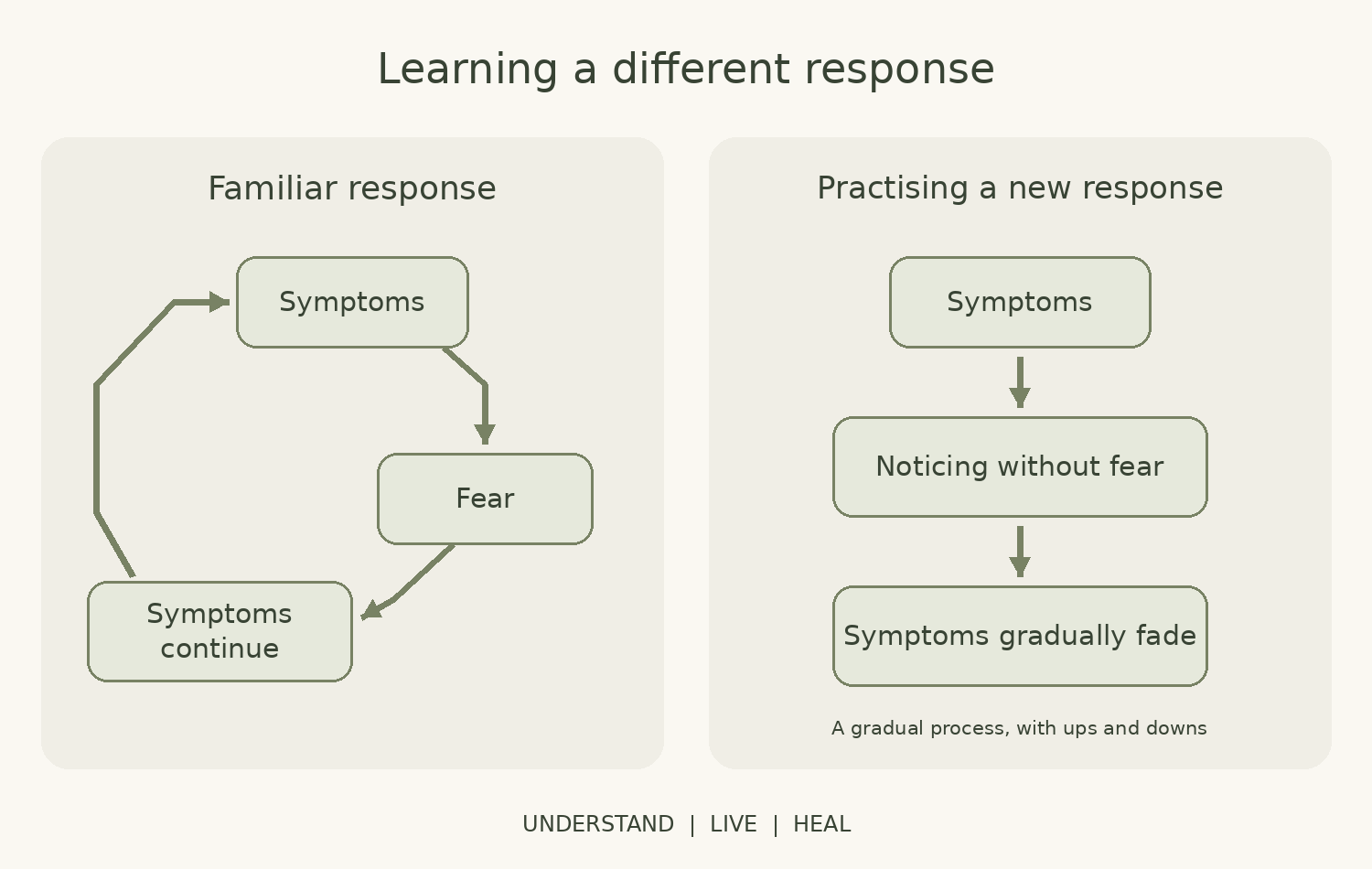
A symptom sensation can trigger fear. Checking and monitoring may then draw more attention to it and turn the alarm up further. The symptom can feel more threatening, and the loop repeats. For symptoms already assessed, learning to respond with less fear and less checking will help interrupt this pattern.
When fatigue leaves very little capacity
If you are living with severe fatigue, even ordinary activities can feel beyond reach. Rebuilding what you can manage, where possible, needs to happen very slowly and at your own pace. Progress can be slow and, for a while, may feel like one step forward and two steps back.
When nervous-system sensitisation is part of the picture, a shift in mindset—beginning to lose the fear of symptoms and the dread that “this will never end”—can be a huge step forward in recovery. Even if this is all you have capacity for in this moment, it is enough. You can begin by reminding yourself that change is possible, without needing to force yourself to do more. Your mind is powerful!
When sensitisation is part of the picture, small, manageable experiences can help your nervous system learn a different response. A setback does not automatically mean “It is not working” or that you have lost your progress. You can meet familiar symptoms with less fear, rather than treating every fluctuation as a disaster.
For me, the heart of this work was learning not to fear every familiar symptom, and remembering: “I am not broken. Change is possible. I can do this, one step at a time.” You do not have to force yourself to feel confident immediately. Let that trust grow through small, manageable experiences, without turning recovery into another test you have to pass.
Returning to life does not have to mean going for a walk or doing more physically. It can begin with a small moment of pleasure, connection or choice within the energy you have available.
If activity makes you worse later that day or in the following days, respect that response and adjust. There is no need to push through or increase activity on a fixed schedule.
You can explore a less fearful response to familiar symptoms while also respecting your body’s needs. Rest and reconnecting with life can exist together.
My roadmap out
1 Knowledge comes first
Learn how the brain and nervous system work, how sensitisation can develop, and how fear and attention can maintain symptoms. I can help you with this. You can book an in-person or online appointment with me, so we can explore this understanding together and find tools that feel helpful for you.
For me, understanding how my brain had caused my symptoms, and that my brain is plastic — able to learn and change — was incredibly empowering. Realising I could change my brain and that my symptoms could change with it really helped me let go of fear.
Letting go of the fear of my symptoms and learning to feel safe went hand in hand. As I began to understand what was happening, the sensations felt less threatening. I could respond with more confidence: “I understand this. I can feel these sensations and still be safe.”
Feeling safe didn’t mean waiting until every symptom had disappeared. It meant gradually trusting my body again and returning to life, even when symptoms were present. I didn’t force myself to stop being afraid; understanding and experience helped that fear soften over time.
2 Stop searching endlessly for the cure
After appropriate medical assessment, begin stepping out of the endless cycle of Googling, checking and trying another fix. For me, constantly searching kept reinforcing the message that something was terribly wrong.
3 Accept where you are now
"This is where I am today." You do not have to like it, or decide it is forever. Acceptance means making room for the present without spending the whole day arguing with it. You can want change and still stop fighting this moment.
4 Notice the fear path and drop the rope
Be aware when your mind heads into "What is wrong with me? What if this never ends?" Notice the thought without chasing it. Gently remind yourself: "I can meet this without panic. I am safe enough in this moment." Then return your attention to what you were doing. You do not need to repeat reassurance until the feeling disappears. Just carry on with life despite the symptom.
Imagine a tug of war with your symptoms. Dropping the rope means ending the struggle, not pretending the symptoms are absent. Let them be there without making them the centre of every decision.
5 Let life back in
Begin wherever you are now and build capacity slowly, at your own pace. Choose small, meaningful or enjoyable experiences and gradually make more room for life.
For me, I stopped cancelling plans and got on with life regardless of how I felt. This was a huge part of healing for me. I stopped waiting to feel completely well before living, and reconnecting with ordinary life helped rebuild trust.
Each time I did something I enjoyed without letting fear make the decision, I gave my brain another experience of safety. Gradually, my symptoms became less frightening and my life became bigger again.
You do not have to wait until you feel completely better to let joy, connection and the things you love back in.
Feelings and trust
6 Make room for real emotions
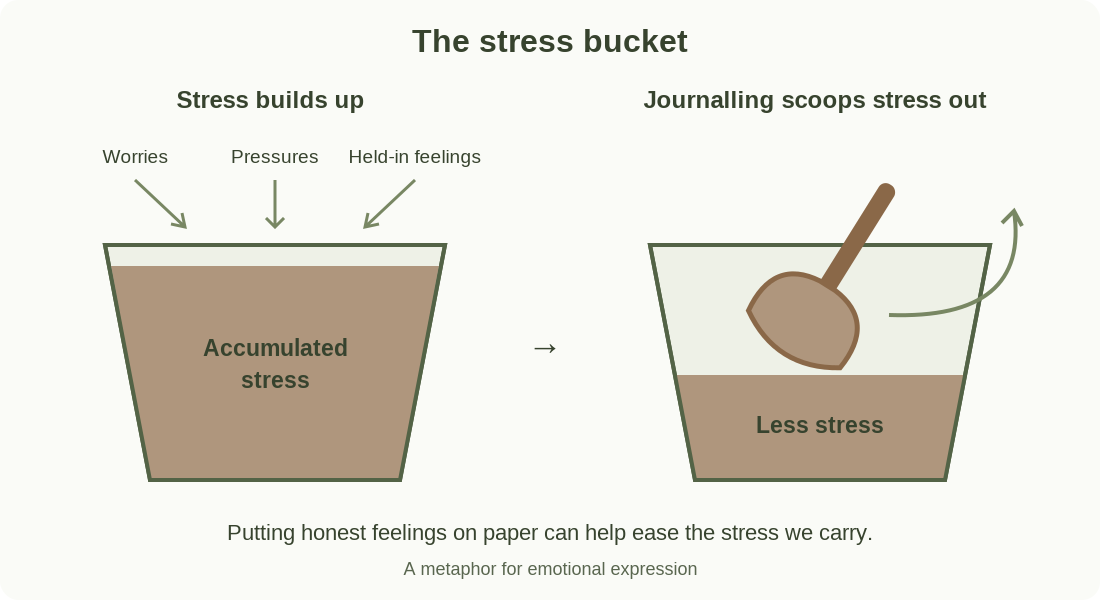
Everyday pressures, worries and feelings we hold inside can build up, like stress filling a bucket. Journalling helped me stop holding everything inside.
I now understand the reactions that looked and felt like MCAS for me through this stress-bucket picture: my bucket was overflowing, and my body was reacting. This is how I make sense of my own experience.
Psychologist James Pennebaker explains that putting feelings into words can help organise emotional experiences in the brain, slow our thinking and help us make sense of what we are carrying. Journalling gives those feelings a place to be expressed and processed.
Think of it as putting a ladle into your stress bucket and scooping some of the stress out. That is how it felt for me: giving feelings somewhere to go, rather than carrying them all inside.
You do not have to dig into past trauma. Start with what is real now: "What am I angry about? What hurts? What am I not saying?" Let yourself rant, get angry, swear or admit the feelings you normally tidy away.
This is not positive-mindset journalling. It is honest, raw emotion on paper. Write for a short, manageable time, then tear it up or safely burn it if you choose. Finish with a quiet moment of self-care.
7 Toxic positivity has no place in healing
Toxic positivity is the belief that you have to think positively and feel grateful 24 hours a day for healing to happen. This is not true, and it is not helpful.
It is okay to have a bad day—or a bad week—when life does not feel great. Fighting that feeling only adds more stress to your bucket. Let the feelings be there without fighting them. Try not to add more thinking, judging or worrying about what they mean.
When you sit with difficult thoughts and feelings, you give yourself room to process them—to “digest” them and let them pass through, rather than holding them inside. Think of it as putting a ladle into that stress bucket.
It is okay not to be okay. You do not have to feel positive all the time to move forward.
8 Practise trust before you feel completely better
The biggest change for me was stopping fearing my symptoms and beginning to believe I was physically safe before I felt well. It felt paradoxical: I had been waiting for recovery to give me confidence, but confidence helped me change my response — and recovery followed for me.
That trust came alongside medical assessment and learning. I practised allowing familiar sensations, loosening my grip and making choices that were not governed by fear.
9 Connect with daylight and the earth
Watching the sunrise has become part of my daily life and recovery. After making healing my full-time job, I had to learn to let go of the pressure to do every practice perfectly. I aim to see the sunrise every day, but I am not obsessive about it. If I miss it, I do not beat myself up. It is something I enjoy, not another rule I have to get right. The tools can be helpful without becoming the centre of my life or adding more stress to my bucket.
Morning daylight helps give the body clock a daytime cue, supporting the circadian rhythm that helps organise sleep and wakefulness. Simply being outside to enjoy the sunrise is enough; you do not need to make it a complicated practice.
I also practise grounding by standing on the earth. For me, feeling the ground beneath my feet and being outside helps me feel present and connected. I experience these moments as reminders of safety: I can pause, notice my surroundings and simply be.
10 Give it time
You do not need to do these steps perfectly or spend every waking hour monitoring progress. Use yoga, breathwork, sound, rest or quiet time when they feel supportive. They do not have to become rituals you must perform to prevent symptoms. Setbacks do not erase what you have learned; adjust, be kind to yourself and keep room for life.
Something else that helped me
Drinking lightly salted water made a huge difference to how I felt. My blood pressure had been low. Adequate blood pressure helps deliver blood carrying oxygen and nutrients throughout the body, including to the brain.
When I began drinking lightly salted water, my blood pressure rose and my brain fog began to lift. I noticed clearer thinking, more energy and better sleep. This was an important part of my recovery and taught me to pay attention to my individual physical needs alongside the emotional work.
I’m sharing what I noticed when my own blood pressure was low. Extra salt can raise blood pressure. Always check blood pressure first and take medical advice.
My hope for you
This is my roadmap: the understanding and changes that helped me reconnect with my life.
My hope is that sharing it gives you something useful to explore, helps you feel less alone, and supports an environment in body and mind where recovery may become possible.
You do not have to wait until you feel completely better to find moments of joy, connection and living.
Would you like my support?
If you recognise yourself in my story and would like my help, you can borrow some of my confidence while you begin to build your own. We can work together, slowly and at your pace, making space for you to be heard and exploring understanding, yoga, breathwork and other tools that feel right for you.
Appointments are available in person in Heacham or online.
Contact me for pricing and availabilityBefore using this guide
This booklet shares my lived experience and general education, not a diagnosis. Seek medical assessment for new, severe, persistent or changing symptoms. Continue necessary treatment and discuss medication changes with your clinician.
Background reading
John Sarno, Healing Back Pain; Alan Gordon and Alon Ziv, The Way Out; Howard Schubiner, Unlearn Your Pain.
Evidence and guidance: NINDS, Pain (ninds.nih.gov/health-information/disorders/pain); Ashar et al., JAMA Psychiatry 2022, doi:10.1001/jamapsychiatry.2021.2669 (selected primary chronic back pain); guidance on managing limited energy and delayed worsening after activity.
Would you like to hear about future sound baths, yoga and events? Sign up for occasional emails.