
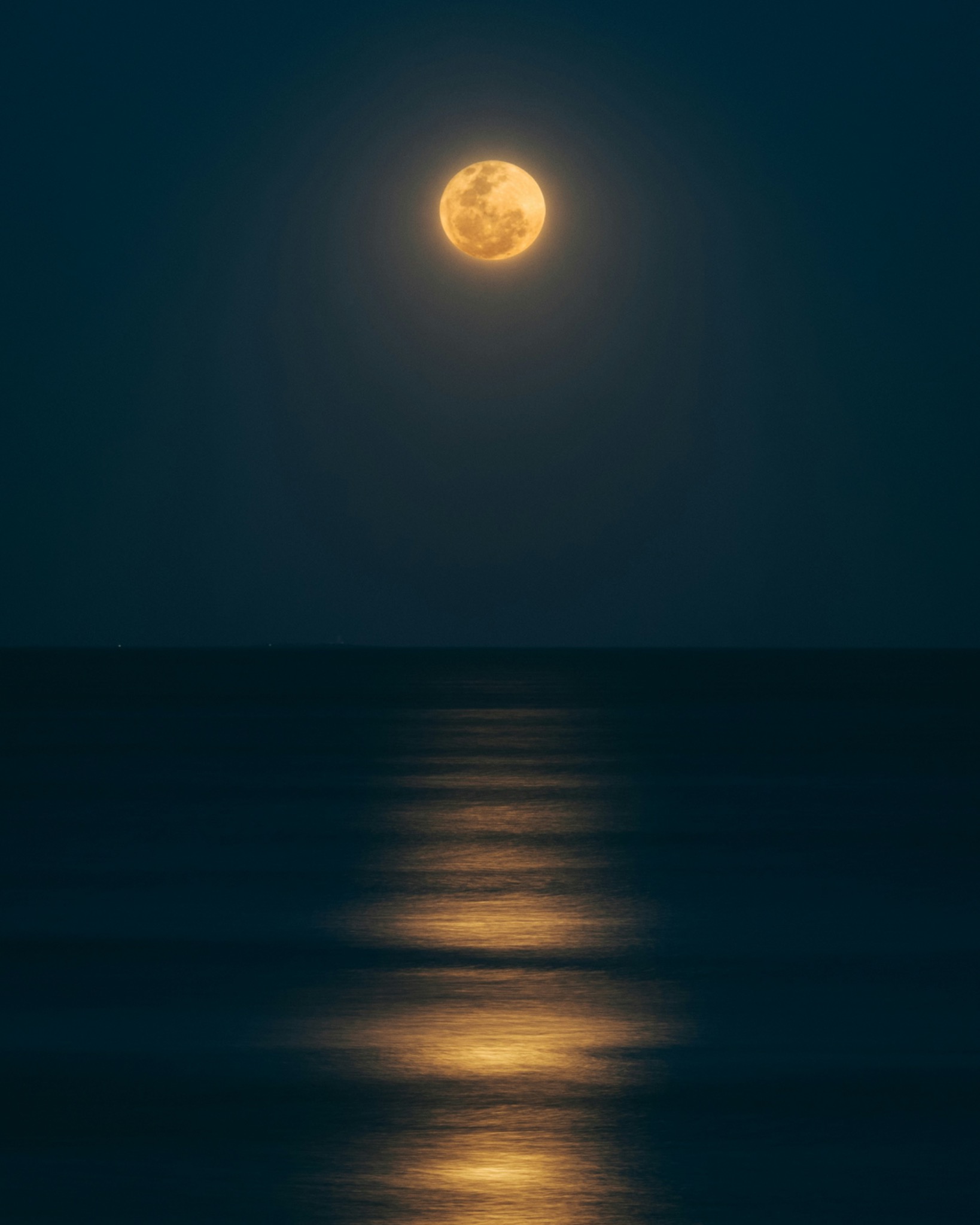
As we approach October’s Hunter’s Moon, I’ve been doing some research after a few nights of less-than-brilliant sleep.
This morning, I looked out of my lounge window in Norfolk and saw a huge moon sitting over the ocean. My immediate thought was: “That’s why my sleep has been bad. And perhaps that’s why my husband was down yesterday!”
I’ve noticed a pattern in both of us. Interestingly, I deliberately don’t follow the moon cycles anymore. Through my experience of the mind–body connection, I’ve become aware of how expectation can shape what we experience. If I’m anticipating a terrible night, what am I already telling my brain?
Yet sometimes I notice the sleep first and the moon afterwards. That’s what gets my attention.
My sleep changes before the moon is full
Our patterns seem different:
- For me: difficulty falling asleep and lighter sleep, usually four or five days before the full moon.
- For my husband: lower mood in the day or two beforehand.
- By the full moon itself: I’m often sleeping well again.
We’ve certainly had a few arguments around that time! Whether the moon contributes is something I’m curious about.
One discovery particularly interested me: my timing appears in published research.
A 2021 study of sleep across the lunar cycle found that people fell asleep later and slept for less time in the three to five nights before the full moon. Researchers observed the pattern in Indigenous communities in Argentina and in students living in Seattle.
I’d assumed the full-moon night would be the obvious time. Finding that earlier window made me want to understand more.
The study considered evening moonlight as an explanation. But what fascinates me most is the possibility of an influence beyond the light.
The pull we cannot see
Living by the coast, I watch the sea advance and retreat, revealing and covering the beach. The moon’s relationship with those movements is extraordinary.
There is a gravitational pull on the water in our oceans, and we contain a great deal of water ourselves. Naturally, that makes me curious about its relationship with our bodies.
But what fascinates me even more is that the moon’s gravity acts on all matter, including rock. NASA describes how its pull slightly deforms the solid Earth itself. Its influence reaches beyond the sea beneath my window to the ground beneath my feet.
That doesn’t mean our bodies experience ocean-like tides. It opens another question: could our biology respond to subtle changes in this gravitational environment?
A 2026 research preprint, Lunar gravity predicts sleep timing, investigates that possibility. Researchers compared sleep and activity recordings with calculated variations in lunar and solar gravity.
They reported associations with later sleep timing, including around the new moon, when brightness cannot provide the same explanation. In one group, the latest sleep onset occurred approximately five days before the full moon.
The paper is a preprint rather than a peer-reviewed finding, and how such an influence might work remains an open question. What interests me is that researchers are exploring it.
Could we carry an ancient lunar clock?
Perhaps the most intriguing possibility is that we carry an ancient lunar clock inside us.
We accept that our bodies respond to the daily movement from light to darkness. Could we also retain a quieter rhythm connected to the moon—something our ancestors lived alongside long before electric lights and blackout blinds?
Menstrual cycles add another layer. Their timing can be close to the moon’s roughly 29.5-day cycle.
A 2021 study examining long-term menstrual records from 22 women found periods when menstrual cycles temporarily aligned with lunar cycles. The alignment came and went. The researchers proposed that modern lifestyles, including artificial light at night, might influence this relationship.
Perhaps our bodies are keeping time with something we rarely stop to notice.
The rhythms people notice
Alongside measured rhythms are patterns people describe in everyday life.
I briefly worked in a care home, where staff would talk about residents becoming more confused or unsettled as the full moon approached. Similar observations circulate among nurses and police officers, who describe busier shifts or changes in people’s behaviour.
Then there is the spiritual interpretation. The full moon is often associated with heightened emotion, intuition and things coming to the surface. I wonder whether that language sometimes describes an experience people notice before they have an explanation for it.
These different ways of looking at the moon show how widely human curiosity travels when we look at the same mysterious object.
Curiosity without hypervigilance
The psychological lesson for me is learning to notice without becoming watchful for something going wrong.
There is a difference between recognising a pattern and beginning to organise my life around the expectation of it. Checking the calendar, monitoring every sensation and waiting for another bad night could turn curiosity into hypervigilance.
That is why I stopped following the lunar calendar so closely. I can explore a possible connection while leaving each night open.
Some ideas resonate with me more than others. I don’t feel compelled to debunk every unfamiliar suggestion, or adopt it as my belief. My mind remains wide open to what is true, with room to change as my understanding grows.
I can notice a rhythm without making it a rule.
For now, I’m looking out over the ocean, admiring the moon—and hoping for a good night’s sleep.